The perimeter-based security model that has dominated enterprise architecture for decades is collapsing under the weight of modern reality. Cloud migration, remote workforces, SaaS proliferation, and interconnected supply chains have dissolved the notion of a defensible network boundary. Organizations that continue to rely on firewalls and VPNs as their primary security controls are defending a perimeter that no longer exists.
The statistics are unambiguous: sixty percent of breaches in 2023 involved stolen credentials that granted attackers legitimate access through front-door authentication, bypassing perimeter defenses entirely. Zero Trust architecture acknowledges this reality and replaces the failed assumption of trusted internal networks with a principle that applies universally: never trust, always verify.
Identity and Access Control
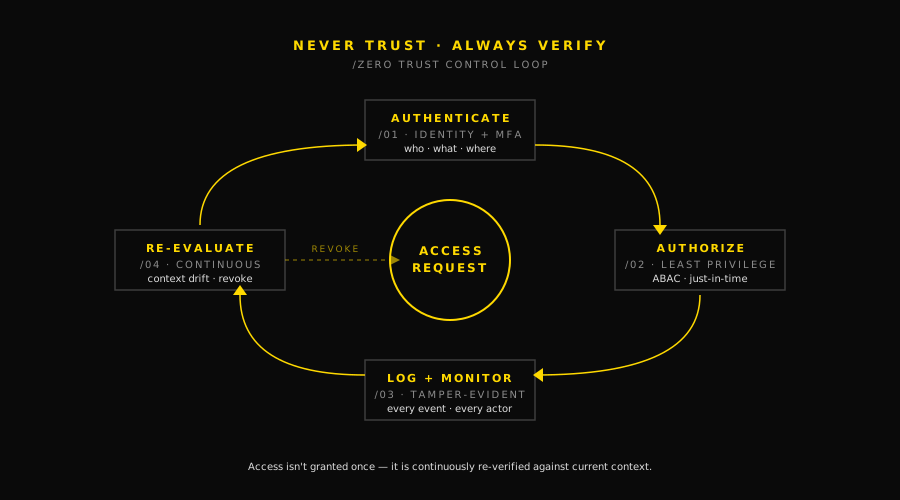
Identity and access control form the first pillar of Zero Trust. Every access request, whether from a user, device, application, or automated process, must be authenticated and authorized before any resource is accessed. Multi-factor authentication is a baseline requirement, not an optional enhancement. Contextual signals including device health, network location, behavioral patterns, and risk scores inform access decisions in real time. Identity is not verified once at login and then trusted for the duration of a session. Continuous re-evaluation ensures that a change in context, such as a device falling out of compliance or a user exhibiting anomalous behavior, triggers immediate access revocation.
The Principle of Least Privilege
The principle of least privilege dictates that every entity receives the minimum access required to perform its function, for the minimum duration necessary. This directly opposes the common enterprise practice of granting broad access based on role or department and leaving those permissions in place indefinitely. In a Zero Trust model, access is granted just-in-time and revoked automatically when the task is complete.
Standing privileges, the persistent access rights that give attackers lateral movement opportunities after initial compromise, are systematically eliminated.
Continuous Monitoring
Continuous monitoring closes the feedback loop that makes Zero Trust operational rather than aspirational. Every access event, every data movement, and every policy decision is logged, analyzed, and correlated in real time. Machine learning models identify anomalous patterns that may indicate compromise or policy violation. Automated response playbooks can isolate affected systems, revoke access, and alert security teams within seconds of detection. This is not a future capability; it is a current requirement for organizations operating in regulated or high-threat environments.
Data-Centric Security: Zero Trust's Apex
Data-centric security represents the ultimate expression of Zero Trust. Rather than protecting the networks, servers, and applications that surround data, protection is embedded directly into the data itself. Encryption, access policies, and audit capabilities travel with every data object regardless of where it moves.
This inversion, from protecting infrastructure to protecting data, is what makes Zero Trust fundamentally different from every security model that preceded it, and why it represents the future of data security.