Protecting Sensitive AI Training Data with Data-Centric Security
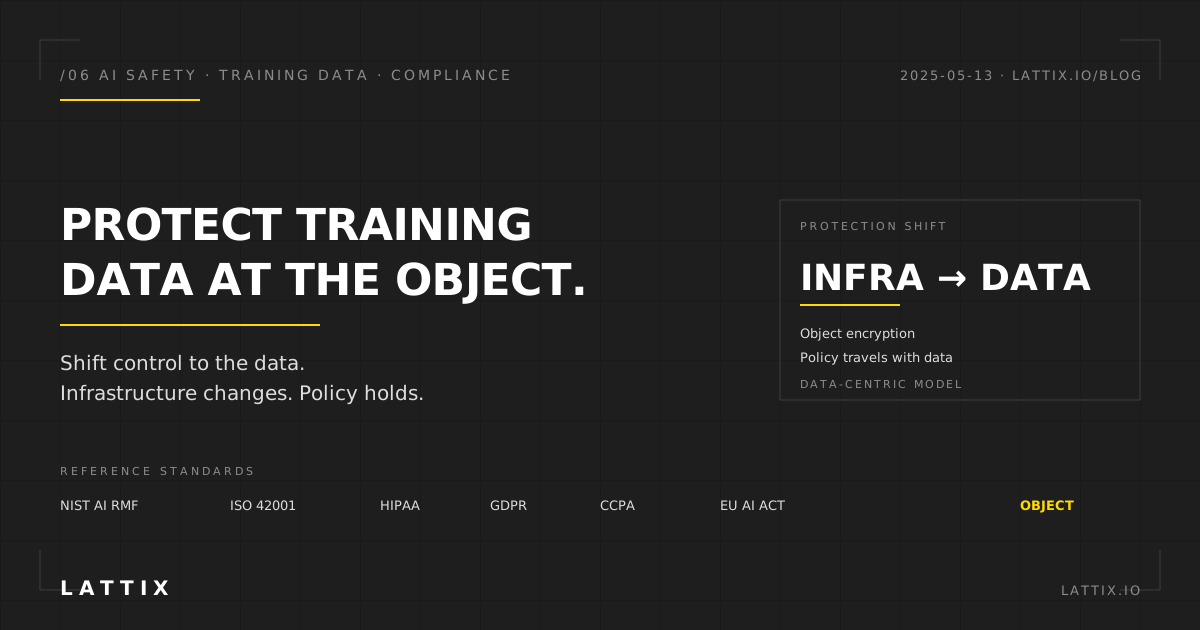
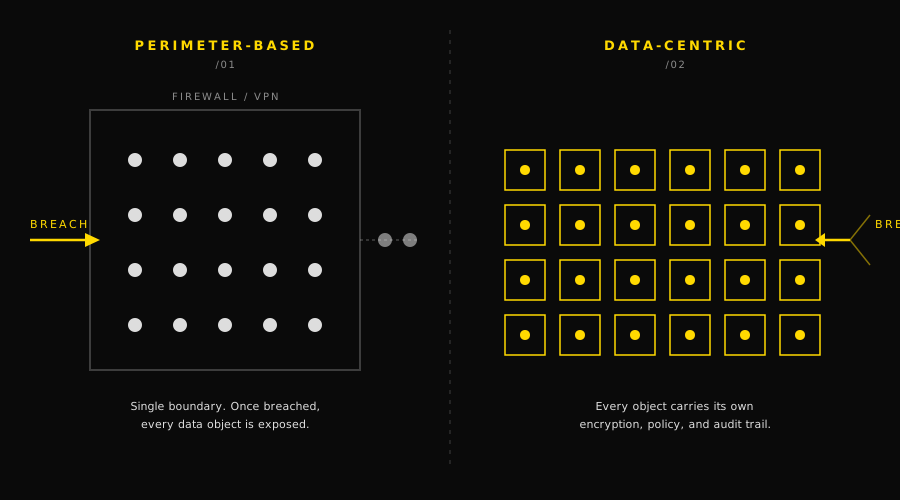
The rapid adoption of artificial intelligence across healthcare, finance, and national security has created a paradox: organizations need vast quantities of sensitive data to train effective models, yet the infrastructure protecting that data was designed for a fundamentally different threat landscape. Traditional perimeter-based security focuses on firewalls, network segmentation, and endpoint protection. But when training data moves between cloud environments, annotation pipelines, and model training clusters, perimeter boundaries dissolve. A data-centric security approach inverts this model entirely, embedding protection directly into the data objects themselves so that security travels with the data regardless of where it resides or who handles it.
Classification and ABAC: the Core Primitives
At the core of data-centric security for AI pipelines is rigorous data classification combined with attribute-based access control (ABAC). Every dataset, every subset used for training, validation, or testing, receives a classification label that reflects its sensitivity level and regulatory category. ABAC policies then govern who can access, transform, or feed that data into a model based on attributes such as the user's role, clearance level, project assignment, and even the security posture of their device. This granularity matters because AI training pipelines involve dozens of actors: data engineers, annotators, ML researchers, and automated orchestration systems. Each requires precisely scoped access, nothing more.
Cryptographic Logging as the Audit Backbone
Cryptographic logging provides the audit backbone that regulators and internal compliance teams demand. Every access event, every transformation applied to a dataset, and every model training run that consumes sensitive data is recorded in a tamper-evident log. Blockchain-anchored logging takes this further by creating an immutable chain of custody for training data. If a model produces a questionable output, organizations can trace backward through the log to identify exactly which data influenced that result and whether any unauthorized modification occurred along the way.
A Healthcare Example
Consider a healthcare organization training a diagnostic imaging model on patient radiology scans. Under HIPAA, those images constitute protected health information. A data-centric approach wraps each image set with encryption and access policies before it ever enters the training pipeline. De-identification processes are logged cryptographically. The ML team accesses only the de-identified derivatives, never the originals, and every access is recorded. If an auditor asks to verify compliance, the organization produces an unbroken chain of evidence from raw data through model output.
Convergence with Regulatory Frameworks
Regulatory frameworks including GDPR, HIPAA, and CCPA are converging on a common expectation: organizations must demonstrate control over sensitive data throughout its lifecycle, not just at rest or in transit. For AI systems, this lifecycle extends through training, fine-tuning, inference, and model retirement.
Data-centric security is not an optional enhancement for AI programs operating under these frameworks. It is the architectural foundation that makes demonstrable compliance possible while still enabling the data access that effective AI demands.