Can You Trust AI? Not Without Securing the Data It Trains On
Trust in artificial intelligence is fundamentally a trust in data. When an AI system recommends a medical diagnosis, flags a financial transaction as fraudulent, or identifies a threat in satellite imagery, the quality of that decision traces directly back to the data used to train the model. Yet most organizations invest heavily in model architecture and compute infrastructure while treating training data security as an afterthought. This gap between model sophistication and data protection is where the most consequential AI failures originate.
Data Poisoning Attacks
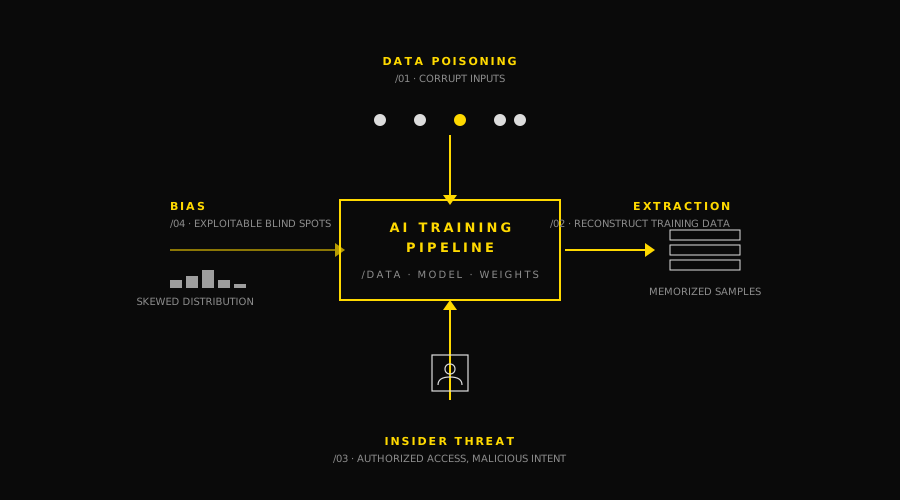
Data poisoning attacks represent one of the most insidious threats to AI trustworthiness. An adversary who gains access to training data can introduce subtle modifications that cause the model to learn incorrect associations. These modifications do not need to be large or obvious. Research has demonstrated that poisoning as little as one percent of a training dataset can cause targeted misclassification in production models.
In a healthcare context, poisoned radiology training data could lead to missed diagnoses. In financial services, poisoned transaction data could train fraud detection models to ignore specific patterns of illicit activity. The damage compounds because organizations typically trust their models implicitly once deployed.
Data Extraction Attacks
Data extraction attacks work in the opposite direction. Rather than corrupting training data, adversaries attempt to reconstruct sensitive training data from model outputs. Large language models have been shown to memorize and reproduce verbatim training examples, including personal information, proprietary code, and confidential documents. For organizations training models on classified or regulated data, this represents a data exfiltration channel that bypasses every traditional security control.
The Insider Threat Dimension
Insider threats add another dimension to the problem. Data scientists and ML engineers typically require broad access to training datasets to do their work effectively. Without granular access controls and comprehensive audit logging, a single compromised or malicious insider can manipulate training data, extract sensitive records, or introduce biases that serve an external agenda. The challenge is particularly acute in national security and defense contexts where adversary-sponsored insiders specifically target AI training pipelines.
Bias as a Security Vulnerability
Bias in training data is not merely an ethical concern; it is a security vulnerability. Models trained on biased data produce systematically skewed outputs that adversaries can predict and exploit. If a threat detection model underperforms on specific categories because those categories were underrepresented in training data, adversaries will concentrate their efforts in exactly those blind spots.
Securing AI training data therefore requires not only protecting confidentiality and integrity but also ensuring representational completeness and statistical validity. Zero trust principles applied to the data layer, where every data access is authenticated, authorized, logged, and verified, provide the foundation for AI systems that organizations can actually trust.