How Blockchain Enhances Cybersecurity in the Era of Digital Threats
Blockchain technology, often associated primarily with cryptocurrency, possesses architectural properties that address fundamental weaknesses in conventional cybersecurity infrastructure. Its core characteristics — immutability, decentralization, cryptographic verification, and consensus-based validation — map directly onto the requirements that security architects have struggled to achieve with centralized systems. As digital threats grow more sophisticated and perimeter-based defenses prove increasingly inadequate, blockchain offers a structural layer that can strengthen cybersecurity from the data level upward.
Tamper-Proof Audit Trails
Tamper-proof audit trails represent the most immediately practical application of blockchain in cybersecurity. Traditional log management systems, even when well-configured, rely on centralized databases that a sufficiently skilled attacker can modify or delete to cover their tracks. Blockchain-based logging distributes audit records across a network of nodes, with each entry cryptographically linked to its predecessors. Altering any historical record requires recomputing every subsequent block and achieving consensus across the network, a computational impossibility in any properly designed system.
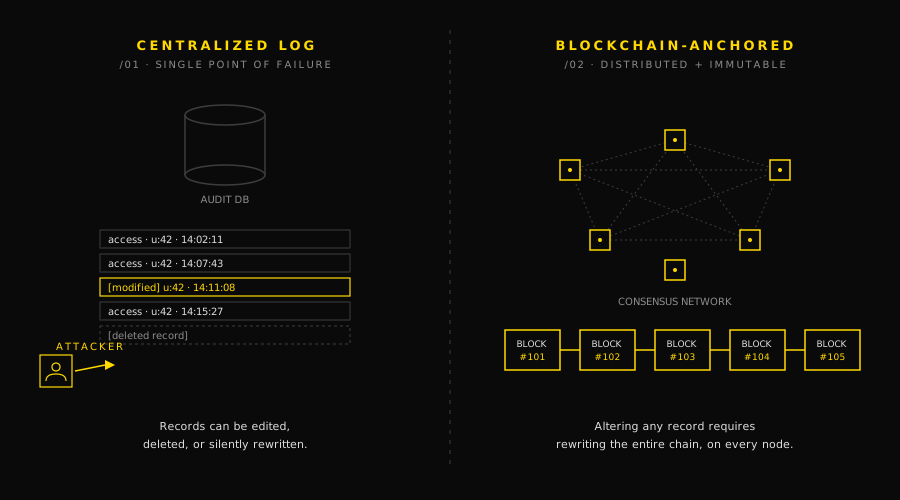
For organizations subject to regulatory audits or operating in adversarial environments, this immutability transforms security logging from a best-effort practice into a mathematical guarantee.
Smart Contracts for Policy Enforcement
Smart contracts enable automated, policy-driven access control that executes without human intervention and cannot be circumvented through social engineering or administrative override. Attribute-based access control policies encoded as smart contracts evaluate access requests against predefined conditions: user identity, device posture, time of day, data classification level, and any other relevant attribute. When conditions are met, access is granted and the transaction is recorded on-chain. When conditions fail, access is denied with an immutable record of the attempt. This eliminates the category of breaches caused by misconfigured access controls, overridden approval workflows, and unauthorized privilege escalation.
Decentralized Identity Management
Decentralized identity management addresses the systemic vulnerability of centralized credential stores. Major breaches consistently trace back to compromised identity providers or credential databases. Blockchain-based decentralized identity allows users and systems to authenticate using cryptographic proofs anchored to a distributed ledger, eliminating the single point of failure that centralized identity systems represent. Self-sovereign identity models give individuals control over their own credentials while still enabling organizations to verify claims through on-chain attestations.
Supply Chain and AI Data Integrity
Supply chain security and AI/ML data integrity round out the cybersecurity applications where blockchain delivers distinct advantages. Software supply chain attacks, where adversaries compromise build systems or inject malicious code into trusted packages, can be mitigated by recording cryptographic hashes of every component at every stage of the build pipeline on a blockchain. Any modification between build and deployment becomes immediately detectable.
Similarly, blockchain can establish provenance and integrity chains for AI training data, ensuring that every dataset used to train a model is traceable to its origin and verified as unmodified. In an era where both software supply chains and AI pipelines have become high-value targets, blockchain provides the verification infrastructure that conventional systems lack.